What Is a Cable Gland? Types, Sizes & Applications (2026 Guide)
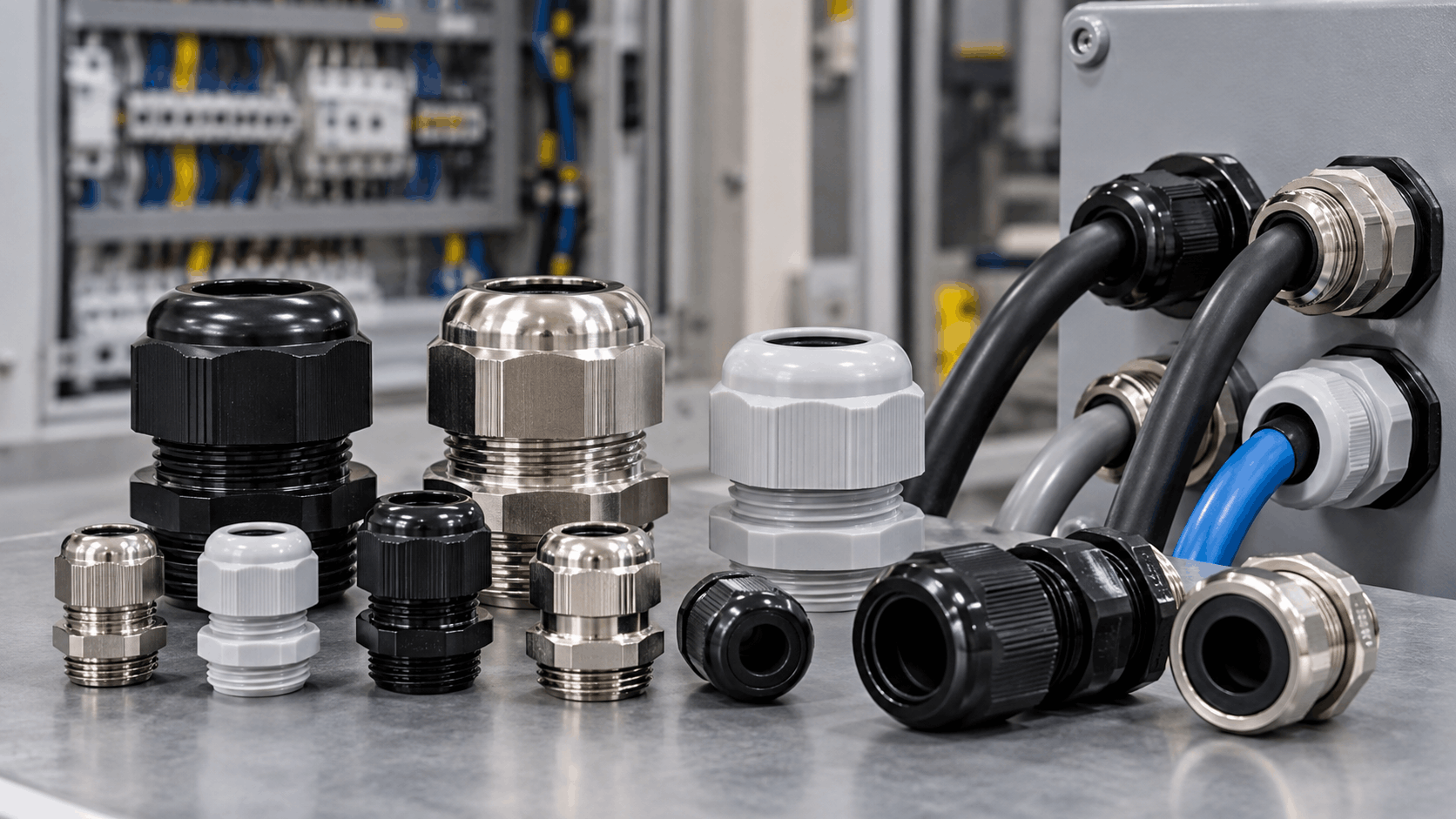
A cable gland is a mechanical fitting that provides a secure, sealed entry point for electrical cables into panels, machinery, equipment and enclosures. It holds the cable firmly, relieves strain, and keeps water, dust, moisture and other contaminants out. Used across industrial plants, automation systems, food production lines and power facilities, the right cable gland protects both the cable and the enclosure's IP rating.
Simplified cross-section: the dome nut compresses the seal insert around the cable, while the lock nut fixes the gland to the enclosure.
What Is a Cable Gland?
A cable gland (also called a cable connector or cable entry device) retains the cable, seals the entry point and protects the cable insulation where it passes through an enclosure wall. Correctly installed, it prevents cable movement, absorbs vibration and pulling forces, and helps the enclosure keep its IP protection rating.
In industrial use, glands also protect against oil, chemicals and electromagnetic interference (EMI). Browse our industrial cable glands to see the full range.
Functions of a Cable Gland
Securely fastens the cable in place (strain relief).
Prevents the ingress of water, dust and moisture.
Protects the cable against pulling forces and vibration.
Maintains the IP protection rating of the enclosure.
Provides a clean, professional cable entry.
Depending on type, provides EMC shielding, armour grounding or explosion protection.
Cable Gland Types Compared
The table below summarises the six main cable gland types. Values are typical; always confirm exact ratings on the product datasheet.
Brass cable glands are among the most widely used in industry thanks to high mechanical strength and long service life. A nickel-plated finish provides good corrosion resistance in demanding environments.
Applications: electrical panels, machinery manufacturing, industrial automation, power and energy facilities, production lines. Advantages: high mechanical strength, corrosion resistance, long life, wide temperature range.
Polyamide (Plastic) Cable Glands
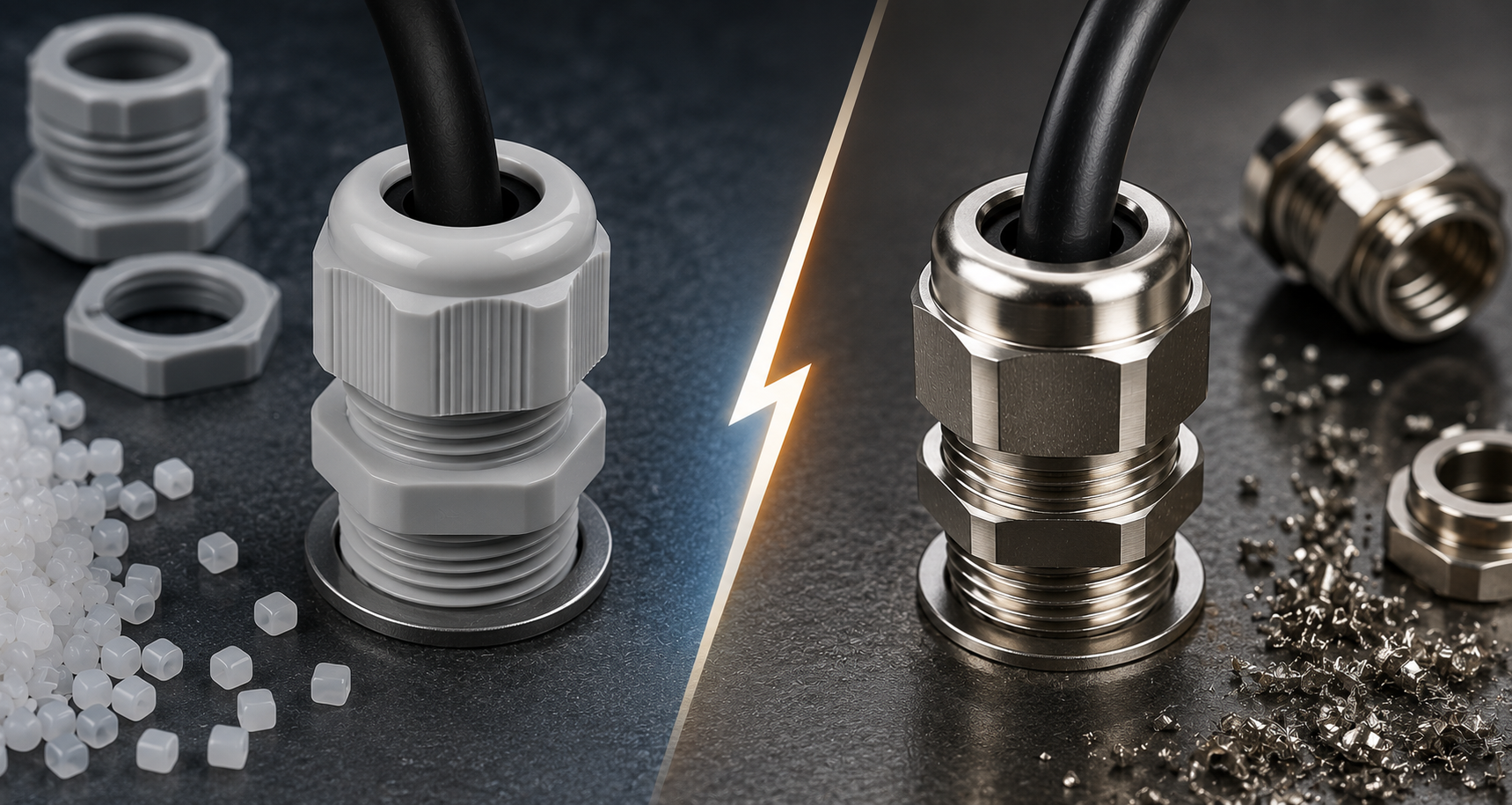
Polyamide cable glands are lightweight, cost-effective and electrically insulating. UV-resistant and flame-retardant versions suit both indoor and outdoor use. For a deeper comparison see Plastic or Metal Cable Gland?
Applications: electrical panels, control boxes, machine wiring, building automation, lighting systems. Advantages: cost-effective, excellent insulation, corrosion-free, easy to install.
Stainless Steel Cable Glands
Stainless steel cable glands, made from AISI 304 or AISI 316, resist harsh chemicals, seawater and washdown environments, and need minimal maintenance.
Applications: food processing, pharmaceutical facilities, chemical plants, marine and outdoor installations. Advantages: superior corrosion resistance, hygienic design, long-lasting performance.
EMC Cable Glands
EMC (Electromagnetic Compatibility) cable glands make direct, 360° contact with the cable shield so electromagnetic noise is discharged safely to ground. They are important wherever sensitive electronics sit next to frequency converters or servo drives.
Applications: PLC control panels, servo motor systems, robotics, industrial automation, variable frequency drives (VFDs). Advantages: reduces electromagnetic interference, improves signal quality, supports EMC compliance.
Armoured Cable Glands
Armoured cable glands terminate armoured cables (such as SWA or braided armour) and provide secure grounding of the armour together with high mechanical strength.
Applications: petrochemical plants, power generation, mining, heavy industry, outdoor power distribution. Advantages: compatible with armoured cables, strong mechanical protection, reliable grounding.
A gland has two sizes you must match: the thread that fits the enclosure entry and the cable diameter range the seal can close around. Metric, PG and NPT threads are not interchangeable. NPT is a tapered thread; metric and PG are parallel threads. For the full reference, see our cable gland size chart (metric, PG & NPT).
Metric (M) threads
Thread
Thread outer diameter
Typical cable range*
M12 x 1.5
12 mm
3 – 6.5 mm
M16 x 1.5
16 mm
4 – 8 mm
M20 x 1.5
20 mm
6 – 12 mm
M25 x 1.5
25 mm
13 – 18 mm
M32 x 1.5
32 mm
18 – 25 mm
M40 x 1.5
40 mm
22 – 32 mm
M50 x 1.5
50 mm
32 – 38 mm
M63 x 1.5
63 mm
37 – 44 mm
*Typical ranges for standard glands. Exact cable ranges differ by product — check the datasheet.
PG threads
Thread
Outer diameter
PG7
12.5 mm
PG9
15.2 mm
PG11
18.6 mm
PG13.5
20.4 mm
PG16
22.5 mm
PG21
28.3 mm
PG29
37.0 mm
PG36
47.0 mm
PG42
54.0 mm
PG48
59.3 mm
NPT threads
Trade size
Thread outer diameter (approx.)
1/2″ NPT
21.3 mm
3/4″ NPT
26.7 mm
1″ NPT
33.4 mm
1-1/4″ NPT
42.2 mm
1-1/2″ NPT
48.3 mm
2″ NPT
60.3 mm
IP Ratings Explained
The IP code shows protection against solids (first digit) and liquids (second digit). A gland should have an IP rating at least equal to the enclosure it enters.
IP rating
Protection
Typical use
IP54
Limited dust ingress; splashing water
Indoor, dry or lightly exposed
IP65
Dust-tight; low-pressure water jets
Indoor washdown, light outdoor use
IP66
Dust-tight; powerful water jets
Outdoor, heavy washdown
IP67
Dust-tight; temporary immersion (up to 1 m, 30 min)
Areas at risk of flooding
IP68
Dust-tight; continuous immersion (as specified by manufacturer)
Submerged or permanently wet installations
How to Choose the Right Cable Gland (Checklist)
A wrongly selected gland can lower the enclosure's IP rating, damage the cable and compromise safety. Work through this checklist, or read our complete guide to choosing a cable gland:
Measure the cable's outer diameter and pick a gland whose sealing range covers it.
Match the thread type and size (metric, PG or NPT) to the enclosure entry.
Confirm the cable type: armoured or unarmoured, shielded or unshielded.
Check the required IP rating.
Check operating temperature range, including seal material.
Choose the material: polyamide, brass or stainless steel.
Consider chemical, UV and salt-water exposure.
Decide whether EMC shielding is needed.
In hazardous areas, use only glands with the correct ATEX / IECEx certification.
Frequently Asked Questions
What is a cable gland used for?
A cable gland secures an electrical cable where it enters a panel, machine or enclosure. It provides strain relief, seals out water, dust and moisture, and helps keep the enclosure's IP rating. Depending on the type, it can also provide EMC shielding, armour grounding or explosion protection.
How do I choose the right cable gland size?
Match two dimensions: the thread size that fits the enclosure entry (metric, PG or NPT) and the outer diameter of the cable, which must fall inside the gland's sealing range. Measure the cable over its outer sheath, then check the gland datasheet for its minimum and maximum cable diameter.
Should I choose a plastic or a metal cable gland?
Polyamide (plastic) glands are light, insulating, corrosion-free and cost-effective, which suits control boxes and building automation. Metal glands (brass or stainless steel) offer higher mechanical strength and temperature resistance, and are required when you need EMC shielding or armour grounding.
What IP rating does a cable gland need?
Use a gland with an IP rating at least equal to the enclosure's rating. IP65/IP66 is common for dust and water-jet exposure, while IP67/IP68 is used where temporary or continuous immersion is possible. The rating only holds when the gland is correctly matched to the cable and tightened properly.
When do I need an Ex-proof (ATEX) cable gland?
Whenever the gland is installed in a hazardous area with explosive gas, vapour or dust. These glands must carry the correct ATEX / IECEx certification and protection type for the zone. Standard industrial glands must never be used in hazardous areas.
Conclusion
Cable glands are essential for safe, reliable cable entries in electrical and industrial automation systems. Brass, polyamide, stainless steel, EMC, armoured and Ex-proof glands each suit different environments; choosing by thread size, cable diameter, IP rating, material and certification protects equipment, reduces maintenance and extends service life. Explore our full range of cable glands or contact our team for help selecting the right one.
Plastic or Metal Cable Gland?
& 26/08/2026
Cable Gland Size Chart (Metric, PG & NPT)
& 10/08/2026
What Are Ex-Proof Cable Glands?
& 04/08/2026
How to Choose the Right Cable Gland (Complete Guide)


-bimed.png)